


What Tomorrow's Employers Will Want From Today's Students
October 16, 2026
|
The students in elementary school classrooms today may eventually pursue careers that don’t yet exist, using technologies we haven’t imagined. Some will enter fields transformed by artificial intelligence, while others may help create entirely new industries. How do we prepare children for a future that even the world’s leading employers can’t fully predict? Research is beginning to share what employers will need from the next generation. The World Economic Forum’s Future of Jobs Report 2025 estimates that 39% of workers’ existing skill sets will change or become outdated by 2030. |
 |
Employers increasingly prioritize analytical thinking, creativity, resilience, flexibility, curiosity, and lifelong learning, along with technology and AI literacy skills. Research from the McKinsey Global Institute reinforces the importance of these capabilities, identifying 56 skills across cognitive, interpersonal, self-leadership, and digital domains that can help people thrive in a changing workplace.
For schools, preparing students for this future requires much more than teaching them to use the latest technology. Schools must also consider how children learn to evaluate information, approach unfamiliar challenges, and make decisions when there isn’t an obvious right answer.
What Future-Ready Skills Will Matter Most?
As artificial intelligence becomes increasingly capable of analyzing information and completing complex tasks, the ability to evaluate its output becomes especially important. Having access to an answer is not the same as knowing whether that answer is accurate, useful, or appropriate.
Dr. Lori-Anne Brogdon, head of school at Mounds Park Academy (MPA), believes students will need to become increasingly critical consumers of information.
“With more access to information via AI, our students will need the skills to discern what is credible through the use of their critical thinking skills,” she says. That includes “knowing how to ask the right questions, addressing bias in data, determining the validity of the source, and having the ability to make connections across all the sources of information they will have access to.”
Critical thinking doesn’t happen in a vacuum. It depends on a strong foundation of knowledge across disciplines. Students need enough understanding of the world to recognize when something doesn’t make sense, question assumptions, and consider perspectives beyond their own.
 |
Dr. AnnMarie Thomas, University of St. Thomas professor emerita of engineering and business, Listo Idea Co. founder, and MPA parent, believes that breadth of knowledge will also be essential to creativity and innovation. “One of the best parts of human creativity is that it is derived from the unique experiences that each human has. A lifetime of books read, conversations had, classes taken, movies watched, all come together to allow for new ideas,” she shares. |
Thomas points out that evaluating new technologies requires more than technical expertise. Understanding history, sociology, psychology, and sustainability helps people consider not only what technology can accomplish, but whether and how it should be used. A broad education that encourages students to explore different disciplines, perspectives, and interests may therefore be one of the best ways to prepare them for a changing world.
Preparing Students For Jobs Of The Future
If schools cannot predict the specific careers their students will pursue, they can focus on helping children become capable, independent learners who are comfortable navigating new situations.
“As educators, it is our role to properly prepare students for the unpredictable,” Brogdon explains. “We can do this through continuing to foster the curiosity and confidence our students already have and prevent them from becoming passive learners, knowing AI will only continue to grow in its capabilities.”
At MPA, an independent PreK-12 school serving the Twin Cities, this means giving students problems that don’t have obvious answers and the opportunity to work through them independently and with others. Sometimes they’ll struggle, disagree, or discover that their first approach doesn’t work. Those experiences are an important part of learning.
This philosophy is reflected in MPA’s Competencies for Future-Ready Learners. The competencies identify the knowledge, skills, and dispositions students need to navigate an increasingly complex world, including investigating through inquiry, communicating ideas, designing solutions, reasoning quantitatively, learning in community, and leading one’s own learning. The competencies help students develop the ability to use what they know and complement content knowledge. A student might understand a scientific concept, for example, but applying that understanding to an unfamiliar problem requires additional skills. They must determine what information is relevant, decide how to proceed, evaluate evidence, and sometimes reconsider their original assumptions.
Hannah Sullivan, an Upper School science teacher, believes this approach is essential. “I think MPA’s competencies are a good reminder that it’s not necessarily the activities we do in the classroom or the content we deliver that matters most, but it’s how we help students build the skills to be able to learn and adapt to an ever-changing future.”
What Does Future-Ready Learning Look Like in the Classroom?
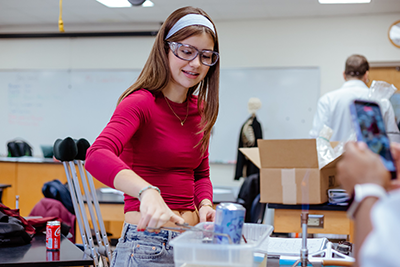
In Sullivan’s chemistry classroom, students participate in an Unknowns Lab that challenges them to identify chemical substances from 17 possible ionic compounds. They begin with a foundation in chemical reactions and laboratory techniques, but eventually must determine their own approach to identifying the unknown substances. Working with partners, they develop a plan, conduct tests, collect evidence, and make decisions based on their findings.
Identifying the compounds is only part of the challenge. Students must explain their reasoning, listen to one another, navigate disagreements, and adjust when something doesn’t work. The lab brings several of MPA’s competencies into play at once, and students become so engaged in the challenge that some voluntarily return during study halls or after school to investigate additional substances.
|
Sullivan takes a similar approach in neuroscience, where students gradually progress from structured experiments to independent research projects. They collect and analyze original data related to the mammalian diving reflex, then design experiments involving upside-down goggles, study sensory receptors, and participate in a class-wide sleep study using EEG equipment. By the end of the course, they have developed the skills to pursue questions of their own choosing. |
 |
“Perhaps I can’t hope to adequately prepare them for the challenges we haven’t even imagined yet, but I can equip them with the skills they need for the ongoing process of adaptation and self-preparation and the background information to be a knowledgeable, effective citizen in the world.”
For Sullivan, an important part of this work is helping students discover that challenging learning can also be deeply enjoyable. She wants students to become so engaged in what they are doing that they almost don’t realize how much they are learning. For Sullivan, that enthusiasm can be just as meaningful as getting the right answer.
AI In Education Needs The Human Perspective
As technology becomes more capable, questions about its appropriate use become increasingly complicated. AI may be able to generate a solution, but people still need to determine whether that solution is ethical, responsible, and beneficial to others.
“With the continued growth of AI capabilities, what I believe will be of greatest value are the interpersonal skills,” Brogdon says. She believes empathy, creativity, ethical judgment, and reasoning will play a tremendous role in determining when, whether, and how AI should be used.
 |
Thomas believes that learning to navigate uncertainty is essential to innovation. “When you set out to create something new, you have no way of being certain that it will work. By definition, something new has not been done before.” Giving students opportunities to experiment, encounter setbacks, and try again helps build the perseverance they’ll need throughout their lives. She says, “As educators and parents, instilling perseverance and resilience in our children is one of the best gifts that we can give them.” |
We can also help students develop a sense of agency. Rather than waiting for someone else to provide instructions or answers, let students learn that they can ask meaningful questions, test their ideas, and contribute something of their own. That confidence may prove especially valuable in a workplace where technology can perform tasks, but people remain responsible for deciding what is worth pursuing, when, and why.
Preparing For Possibilities We Can’t Yet Imagine
For parents wondering how to prepare their children for an uncertain future, the answer may be less about knowing the next technological breakthrough and more about urging them to explore their interests, ask questions, and develop confidence in their ability to learn something new.
Thomas offers advice that applies to children of every age: “I strongly believe that the more our children learn about the world, the more tools they will have to use in the future, regardless of what careers they choose.”
And schools have an important role to play in fostering environments where students encounter different perspectives, pursue meaningful challenges, and discover what they can accomplish. At Mounds Park Academy, educating students for the future has never meant preparing them for just one destination. It means helping them develop the knowledge, character, and capabilities to pursue possibilities they may not yet have imagined, including opportunities that don’t yet exist.
The future will undoubtedly bring opportunities and challenges we can’t yet imagine. What matters is that students leave school believing they have something meaningful to contribute to what’s next.