May 14, 2026
 Coding might sound like something reserved for older students or tech experts, but in today’s classrooms, even our youngest learners are beginning to explore the foundations of computational thinking. At Mounds Park Academy, that learning doesn’t begin with screens or complicated programs. It begins with hands-on play, movement, collaboration, and problem-solving.
For parents, it’s helpful to know that coding in kindergarten isn’t really about screen time—it’s about thinking. It’s about breaking down problems, giving clear instructions, testing ideas, and learning through trial and error. Technology becomes one tool for extending that learning.
In Katie Roche’s kindergarten classroom, students began their coding journey in a very “analog” way, with no devices required. Using a simple grid taped onto the classroom floor, students worked together to solve a challenge: reach the treasure while avoiding obstacles. They planned routes, counted steps, tested ideas, and adjusted when things didn’t go as expected.
To make the activity even more engaging, Ms. Roche introduced students to the idea of the “turtle” from the early programming language Logo. Students practiced giving step-by-step directions—move forward, turn left, turn right—to guide a classmate across the grid. Along the way, they practiced sequencing and directional language and learned just how important clear instructions can be.
That physical, hands-on foundation is an important part of the process. Before introducing technology, students build a concrete understanding of sequencing, directionality, and cause-and-effect. They experience what it means to “debug” a mistake when a path doesn’t lead where they expected it to.
As students grew more confident, the learning expanded through a Lower School initiative involving MPA’s Library, Makerspace, and Technology (LMT) department. Working alongside Ms. Stephanie Kollm, librarian and media specialist, and Mr. Keith Braafladt, Makerspace coordinator and technology and design innovation teacher, students began transitioning those same concepts into digital tools.
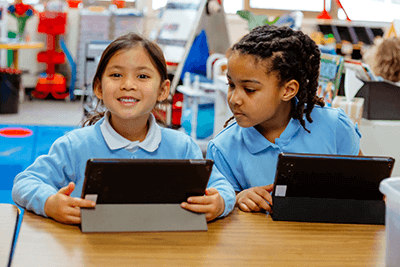
Using iPads and the app Scratch Jr, kindergarteners translated their physical coding experiences into simple digital programs. Scratch Jr is designed specifically for young learners, using colorful coding blocks that snap together to create sequences and animations.
Students also continued working hands-on. They practiced building coding sequences with paper tiles representing commands like moving forward, turning, or repeating actions—one favorite activity involved making the Scratch cat dance. Students arranged paper tiles into a sequence, experimented with repeated movements, and even acted out the dances themselves as they tested their ideas.
Once students felt confident in their plans, they photographed their paper sequences and used the images as guides while recreating the programs digitally on their iPads. The process helped students see the connection between planning, testing, and creating.
Later, students tackled another challenge: helping Michael Moran, director of academic technology, reach a can of sparkling water across the room. Once again, the process began away from screens. Students counted steps, selected coding tiles, worked collaboratively to sequence commands, and physically tested their solutions before moving to the digital version.
Because students had already explored the problem tangibly, the technology itself never became the focus. Instead, the iPads became tools students could use with confidence and purpose. They understood what each command meant because they had already experienced it through play and experimentation.
This analog-to-digital approach offers important benefits for young learners. Students build a strong understanding before adding technology into the mix. They learn perseverance as they revise mistakes and try again. And they develop creativity and collaboration by sharing ideas, solving problems together, and testing different possibilities.
Most importantly, students begin to see themselves as creators and problem-solvers. Whether they are navigating a floor grid, programming a dancing cat, or solving a classroom challenge together, they are building confidence through curiosity, experimentation, and joyful learning—skills that extend far beyond coding itself.

