Upper School Division News November 13, 2025

Three Upper School students at the Nitro Ball Tournament.from Mark Segal, Upper School director

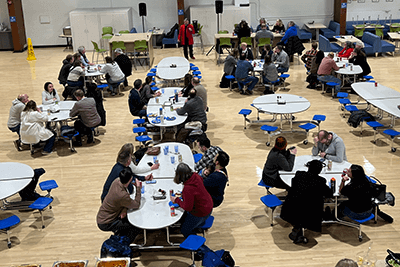
Last week, I had the privilege of visiting our partner school, Vanke Meisha Academy (VMA), in Shenzhen, China. During my on-campus meetings and classroom visits, I explored both the similarities and differences in the Upper School experience at our two schools. What struck me most were the many similarities between our schools and educational systems; curiosity, resilience, collaboration, and the joy of learning were abundantly visible in both settings.

At the same time, I discovered differences in daily schedules and routines, class pacing, and curricular and extracurricular offerings. These differences are not obstacles, but rather invitations that offer us a mirror to reflect on our own practices, and an opportunity to broaden our students’ and teachers’ perspectives. A study from the Centre for Global Education shares, “international school partnerships encourage students to deepen their learning experiences through learning activities that explore global themes.”

My trip offered me a meaningful window into how our two schools can learn and connect across our cultures and reinforced the benefit of ongoing international travel and partnerships. Even though I was very tired, I returned home energized, inspired, and even more committed to deepening our school’s global engagement. My goal is to apply ideas from my recent visit and find ways for our teachers and students to collaborate on projects, classroom experiences, and cross-cultural understandings that will better prepare our students to be global citizens. Read More


Your MPA Journey—Here’s What’s Next

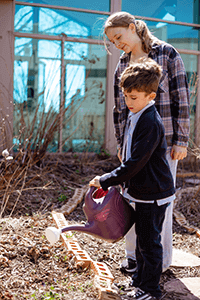
Biology students working in the native plant gardensThis message is from MPA’s Office of Admission from the November 13, 2025 issue of InsideMPA. Click here to get in touch with Admission and learn more!

Thank you to all who attended the PreK-12 MPA Preview on Sunday! Whether you had lunch and conversation with us at the Taste of Ninth Grade or experienced hands-on learning the MPA way, spending the day with each of you was wonderful. If you love what you discovered here, we encourage you to apply today.

If you’re looking to experience life at MPA firsthand, we’re excited to provide a guide of upcoming opportunities to do so! At this point in the year, families are often asking us what next steps they can take in the admission process. Consider this your quick guide to exploring MPA–now is the perfect time to check these off your school search to-do list. The best part? Your contact in the MPA Office of Admission will be your guide every step of the way. Read More


An Update From Former Teacher Karen Franke

The Franke Family Being a teacher has many rewards. None is as great as bumping into one of your students years later and feeling humbled that they recognized you, even though 25 years have passed.

This is what happened to my husband, Tim Franke, this past summer, when he was on the same flight as one of our former students from Mounds Park Academy (MPA).

My name is Karen Franke, and Tim and I had the pleasure of teaching at MPA from 1993 to 1999. It was a unique experience for us as we not only could work in the same school but also within the same grade level, sharing the same students (I taught fifth-grade social studies and language arts, and Tim taught fifth and seventh-grade science). Although this part of our life was a long time ago, we had very fond memories of our time at MPA. So much so that we have reconnected with many of our students on social media over the years. And what we have discovered about those fun, intelligent, well-read, and inquisitive students did not surprise us in the least. Their bright futures were evident to us way back then, given the dedication of the MPA community to ensure that every student reached their full potential. We both smile, thinking, “We knew them when!”

Read More


Then & Now: Speech And Debate

State speech champs 2025

From Ryan Ghose ’21

Since its founding, MPA has taught students to think critically and communicate effectively—and it seems to be working! Nowhere is this excellence more evident than in MPA’s enduring speech and debate programs, where ambitious students join dedicated coaches every day of the week for practices and competitions. I got the chance to catch up with speech coaches Kari Kunze and Tanner Sunderman, and debate coach Katie Murr, to chart how the activities have evolved over the years and what their hopes are for the future of the programs.

Speech

Some quick facts about the speech team:

Team Size

  • 2000: 7 students
  • 2003-2008: 100 students (peak)
  • 2025: 40 students, but most students compete in two categories (“double entering”).

Format

Most categories have stayed the same since the 90s, with the exception of:

  • Duo Interpretation: Introduced in 1996, two people perform an interpretive piece of any genre.
  • Program Oral Interpretation: The newest category, students can compile multiple pieces of writing from different mediums to tell a connected story.
  • Extemporaneous Speaking and Discussion: The advent of Wi-Fi has given way to online databases and the option to search the web for evidence mid-tournament.

Coaches

Many alumni have come back as assistant coaches, but the biggest shift has been a new head coach, Tanner Sunderman, who took over in 2015!

MPA continues to push boundaries in speech, competing in more national tournaments and earning its first national speech and debate association title in 2025. Additionally, Tanner Sunderman shared with me that students last year successfully presented in front of the MSHSL to change the format of Great Speeches to allow for analysis of any type of communication. Check out a tournament next year to see the impacts of MPA students’ advocacy! Read More


A Message from Isaac Marshall ’11

MPA Alum Isaac Marshall '11

When I started at Mounds Park Academy in eighth grade, I was uncertain about how I’d fit into a community that had already been together for years. Rather than making me feel like an outsider, the small class sizes and welcoming peers helped me settle in and find my place. I quickly came to know everyone, and everyone knew me.

MPA gave me more than just a sense of belonging. From analyzing diverse perspectives to tackling problems across disciplines, MPA’s curriculum taught me to approach challenges creatively and think critically. Ms. Conway’s constitutional law class ignited my interest in conducting legal research and structuring arguments years before I knew I wanted to attend law school.

Even today, I’m continuing to discover the value of the foundation MPA helped me build. Read More


Parents Association News And Events November 6, 2025

Parents cheer on Lower School students during the Halloween Parade. In case you missed it, stay in the loop with the Parent Press: November Edition!

Save The Dates!

Below is a preview of exciting opportunities for families to build community at MPA through the winter. Don’t miss your chance to volunteer, donate, and/or show up for the fun!

  • Monday, December 1: Community-Wide Parents Association Meeting
  • Monday, December 8- Friday, December 12: Book Festival!
  • Friday, January 23: Family Trivia Night!
  • Thursday, February 12: Lower School Valentine’s Day Parties!

More details to come. We look forward to seeing you around school in the coming months! Please email PA@moundsparkacademy.org with any questions.

Upcoming Events

  • Friday, November 14: Lower School Family Forum, 8-9:45 AM, Martin Lenz Harrison Library
  • Tuesday, November 18: Coffee & Connections With The Head of School, 8-9 AM, Martin Lenz Harrison Library
  • Tuesday, December 9: Middle School Quarterly Coffee, 8-9 AM, PCR
  • Friday, December 12: Upper School Quarterly Coffee, 8-9:30 AM, PCR
  • Thursday, December 18: PA Book Club with Dr. Brogdon, 6-7:30 PM, Martin Lenz Harrison Library, RSVP here >


Where Every Gift Shapes Tomorrow

Two Middle School students working on a project. from Dr. Lori-Anne Brogdon, head of school
When interviewing for the head of school role at MPA, I remember meeting with various members of the community who shared with me their “MPA moment.” Some were tied to a specific experience, while others were connected to a feeling or overarching theme. Now, as a member of the community, it’s a beautiful feeling to be able to share my own MPA moment, or moments, as it seems I experience a new and memorable one each day!

One of my favorites thus far has been hearing from our seniors their own MPA moments. Much like when I interviewed, they share the significance of experiences such as an overnight school trip, a class or club that ignited a new interest, or the friendships made from playing in the band, on a team, or being part of the musical. What I love most is that their memories span from Lower School through senior year.

These MPA moments, and those to come, would not be possible without the incredible support of our community. From November 16-22, we will honor MPA’s mission by coming together to support the 2025 Fall Campaign: MPA, Where Every Gift Shapes Tomorrow.

Your gift toward the fall campaign makes it possible for each member of our community—current and future—to experience their own MPA moment. From curricular and extracurricular experiences to supporting our incredible faculty, staff, and facilities, your generosity ensures the continuity of our impressive program, as well as the school’s ability to turn new dreams into reality. Read More


Meet Your PA Board!

PA Board Member Adi Boeder RisnerMeet the remaining PA board members! We asked board members how long their families have been at MPA, the names and grades of their children, one of their favorite MPA traditions, and if they could swap with their child for one day at MPA, what they would look forward to the most.

Adi Boeder Risner ’02 | Treasurer

This is my eighth year at MPA with my own family, but as an alum, I’ve actually been part of the community for 18 years. My children, Luke (fifth grade) and Levi (second grade), love being part of MPA as well. One of my favorite traditions is the pairing assemblies—I still remember having a fourth-grade buddy when I was in kindergarten, and it’s incredibly special to see my kids enjoy the same experiences. If I could swap places with them for a day, I’d most look forward to going to the library. Having dedicated time to discover new books in a peaceful setting sounds wonderful—and, of course, I wouldn’t miss lunch! These kids are so lucky.

Read More


Choosing What Matters: How Families Find the Best-Fit School

Lower School boy in parachute in PEExamine core values when making school-choice decisions

The average adult makes 35,000 decisions a day. While there is no research on how many decisions a working parent navigates daily, it is likely far more than that average. For parents, selecting the best-fit school for a child involves numerous considerations ranging from academic rigor to school culture. Every family must weigh these factors in relation to their values, hopes, and circumstances.
Many parents today have access to different school types such as traditional public schools, charter schools, private schools, religious private schools, parochial schools, and independent schools. Even within these categories, individual schools vary greatly in philosophy, instructional methods, and student experience. There is no universal best choice. Parents must determine the environment where each child will most effectively learn, grow, and belong; the answer might even differ within a family.

Deciding about school selection

Families often wonder how to thoughtfully approach a decision that holds long-term implications for their child’s education and well-being. Acclaimed decision coach Nell Wulfhart, who specializes in helping individuals navigate difficult choices, uses two exercises with her clients that translate effectively to school selection.

First, parents can create a list of daily-life values that matter most for their child, ranked in order of importance. These are not moral or religious values, but rather conditions that help a child feel engaged and supported such as individualized attention or freedom to explore multiple interests. Then, parents can evaluate which school options align most closely with those priorities. Second, parents can map out what they hope life will look like for their child and family in one, five, and 10 years and determine which school options align with the desired trajectory. Below, two families illustrate how clarifying core values guided them to their best-fit school.

Middle School students raising hands in classBeing seen, heard, and known

As a former middle school social worker, Mindy Ruane learned the importance of belonging during early adolescence. She wanted her children in a school where they would be “seen as individuals.” With this value in mind, Ruane enrolled her then-fifth, third, and first graders at Mounds Park Academy (MPA), a PreK-12 independent school in St. Paul. MPA has a total enrollment of 571 students, featuring an average class size of 15 and student-teacher ratio of 7:1.

“During the first week of school, I asked my son how he liked MPA, and he joyfully replied that ‘he got called on a lot,’” said Ruane. “Knowing that my children’s voices are going to be heard—and that participation is expected—has been transformational for my children. The school culture encourages students to contribute and take ownership of their learning.”

Cultivating interests beyond the classroom

For Kari Kunze-Hoeg and her husband, both of whom valued academics, athletics, and the arts, it was important that their daughters attend a school offering broad opportunities without pressure to specialize too early. Their daughters attended MPA from PreK through graduation and enjoyed the regular inclusion of world languages, the arts, physical education, technology, and more in addition to rigorous academics. In the end, their daughters (MPA ’22 and ’24) pursued basketball, volleyball, theater, and orchestra, and now both attend Wellesley College and play DIII volleyball together.Boys soccer team celebrating win
“At MPA, students are able to pursue multiple activities simultaneously and can achieve excellence,” said Kunze-Hoeg, who is also MPA’s Upper School Spanish teacher. “During my eldest daughter’s senior year, she advanced to the state competition in debate and participated in the state tournament in volleyball—during the same season—which was only possible given the supportive school community.”

Developing critical skills in the digital age

Ruane, now a fifth and sixth-grade English teacher at MPA, believes it is more important than ever for children to learn the writing process, read novels, and practice those skills daily.

“There is no way to entertain yourself to a good education,” said Ruane. “Students must do the work and put in the time to be strong readers, writers, public speakers, and critical thinkers. Too often students are reading excerpts of stories as opposed to full-length novels that force them to slow down and read for a sustained period.”

Ruane has students write in journals daily for 10 minutes straight to build their skills and stamina, so they have more confidence in formal exercises.

Choosing what matters most

Selecting the best-fit school for a child often feels like one of the most consequential decisions a parent can make. Prioritizing values and examining them through a longer-term lens can help parents identify the school environment that most closely aligns with the academic and extracurricular experiences they want for their child.


Lower School Division News October 30, 2025

A Lower School student looks at an FD hat.from James Ewer, Lower School director 

As October comes to a close, we enter a season that calls us to slow down, notice, and give thanks. This is the time of year when students begin to settle into routines and friendships deepen. It’s also a perfect moment to pause and help our children reflect on the people and experiences that fill their lives with meaning.

Gratitude isn’t just about saying “thank you.” It’s about recognizing how others contribute to our joy and growth. When families take time to name moments of kindness—big or small—it helps children understand empathy at a deeper level. They begin to see the world not only through their own eyes but through the experiences of others.

Try weaving gratitude into your family rhythm. At dinner or bedtime, ask your child:

  • Who made your day better today, and how?
  • What’s one thing you’re grateful for that you didn’t notice yesterday?
  • When did you make someone else’s day better?
  • What did you learn about yourself through something that didn’t go as planned?

These moments of reflection help our children grow in compassion, humility, and joy. Gratitude grounds us. It reminds us that even in a busy world, connection is what matters most.

Peace and Love,

Mr. James

SEL in the Classrooms
Lower School students will take part in Social Emotional Learning (SEL) lessons every other week. These lessons will help students build skills in self-awareness, empathy, communication, and problem-solving. In addition, we’ll be offering small groups and lunch bunch opportunities to further support students’ social growth and connection within our school community. Read More