A Vibrant Place To Learn And Grow

students learning to surf in Costa Rica during itermThis message is from MPA’s Office of Admission from the March 10, 2024 issue of InsideMPA. Click here to get in touch with Admission and learn more!

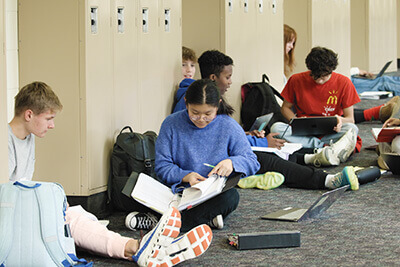
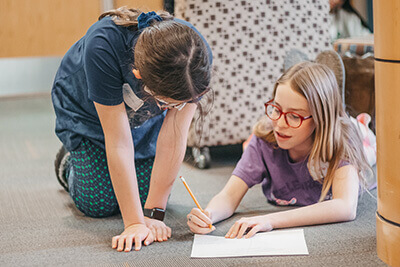
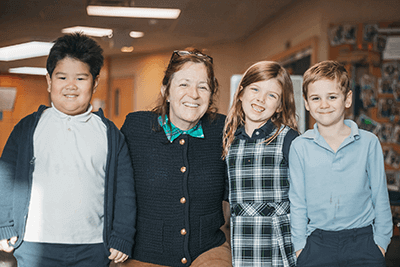
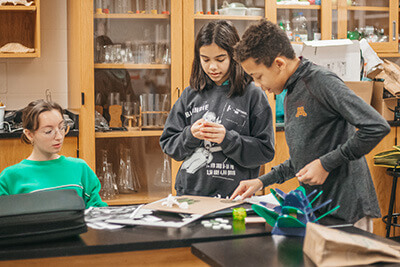
In and beyond the classroom, MPA students are inspired to pursue their aspirations with confidence and curiosity.

Last week, Middle School students embarked on Innovation Term (i-Term). This signature MPA Middle School program offers students a learning experience like no other in a single class of their choice. One week long and entirely ungraded, this is inquiry-based, experiential learning that far exceeds what can normally happen in the classroom. Some chose a French immersion experience in Quebec City. Others observed biology in Costa Rica. No matter which class they choose, students in small, mixed-grade classes go out into the world, work with subject-matter experts, and ignite some serious passions along the way. Read More


If This Is What Matters To You, You’ve Found The Right School

kindergarten celebrating 100th day of schoolThis message is from MPA’s Office of Admission from the March 1, 2024 issue of InsideMPA. Click here to get in touch with Admission and learn more!

At this point in the school year, you may be anywhere on your journey to MPA, from first discovering who we are to making an enrollment decision. You’re probably wondering, “Why do families choose MPA?” Here are just a few of the reasons why students PreK-12 thrive at Mounds Park Academy.

MPA academics are demanding–not draining.
In PreK, our youngest students are digging into a dinosaur fossil lesson to explore how the biology and science of the world in the past influences the future. In their senior year, advanced physics students are venturing out into our community to address problems, and then designing, engineering, and manufacturing 3D-printed tangible solutions. Academic rigor with purpose grounds MPA students in the radical idea that their identity in the world is not measured by a test score, but rather by the depth and decency of their impact on the world.

MPA values collaboration over competition.
Students work together in an environment of support and encouragement where teachers are partners on the journey. Meaningful relationships culminate in the Upper School and last a lifetime. “Within my first weeks here at MPA, I was exposed to a learning environment where people were supporting each other instead of competing with each other,” says MPA alum Ella Jones ’20. “Through discussions with my friends, I have learned more about the world and its political issues in just a year than I had in the first 16 years of my life.”

MPA makes learning joyful.
Creating and nurturing a joyful learning environment is at the heart of MPA. Days at MPA are filled with wonder and exploration that comes with hands-on learning. We believe education is not only about academic achievement but also the holistic development of individuals. Infusing education with joy contributes to the overall well-being and mental health of students. Joyful learning spurs creativity and critical thinking, and MPA students are engaged and enthusiastic to think outside the box, ask probing questions, and seek innovative solutions.

If this is what matters to you, you’ve found the right school.


Being An MPA Student Is…

MPA students working together in a small groupThis message is from MPA’s Office of Admission from the January 27, 2024 issue of InsideMPA. Click here to get in touch with Admission and learn more!

Being a student at MPA is a lot of things.

It’s being part of “A generally really diverse, inclusive environment. I fit in like on day one.”

It’s also a place where you will find “Words of encouragement, even when I didn’t really think I needed it,” and opportunities that make you think, “This experience has just made me a much more confident speaker and critical person.”

And even in addition to all of that, it’s “This safe, nurturing, supportive place where I could really explore and learn so many new things.” Read More


A Day In The Life Of An MPA Student

Two students working togetherThis message is from MPA’s Office of Admission from the December 20, 2023 issue of InsideMPA. Click here to get in touch with Admission and learn more!

What is a day in the life of an MPA student? What do they learn? Where do they study? How do they feel?

To answer all of the above and more, we invite you to join us for the opportunity for to experience life at MPA. Our PreK-12 Preview on January 25, from 8:30-10 AM, gives an inside look at MPA on a school day. This is the perfect opportunity for your family to see yourselves here at MPA. Experience the comfy, cozy library spaces, the Makerspace as bright as your ideas, and the wide-open, welcoming Lansing Center. Your family will be led on a tour by community members and experience delightful surprises that make MPA so special along the way. In addition to exploring our state-of-the-art spaces firsthand, you will also meet the people who make our community the family that it is.

At the Preview, you will discover something remarkable–the type of learning that MPA students do each day. If you have any questions, contact the Office of Admission at 651-748-5577 or admission@moundsparkacademy.org. We hope to see you there!


Transformative Initiatives And Compassionate Support

As Mounds Park Academy continues its commitment to providing a holistic and supportive learning environment, the recent addition of Jeanne Doyle as our Lower School Counselor brings forth a wealth of experience and fresh perspectives. In a recent interview, we explore Jeanne’s initial impressions of MPA, her unique insights, and the innovative programs she has introduced to enhance the Lower School experience.

In your experience, how is MPA different from other organizations you’ve worked for?

“One amazing, unique quality I noticed about Mounds Park Academy right away is that Dr. Hudson truly knows every child’s name! He knows and cares about each student and each MPA family. His love for the children is so genuine. If I were a parent of a child at MPA, this depth of care from the top would be so reassuring to me. As a counselor, I appreciate that feeling seen, known, and loved can foster a strong sense of self-worth in children. Everyone wants to belong in their community. This level of care is echoed throughout the teaching faculty and the staff at MPA, and that is truly a hallmark of our school. Read More


STEAM, The MPA Way

MPA 8th graders building their future cityThis message is from MPA’s Office of Admission from the December 9, 2023 issue of InsideMPA. Click here to get in touch with Admission and learn more!

At MPA, we wholeheartedly embrace STEAM. From utilizing Design Thinking in the Makerspace, to challenging students to find reliable information from reputable sources for research projects, rigor in STEAM takes place PreK-12. Across all of the STEAM fields–science, technology, engineering, the arts, and mathematics–MPA teachers are using their disciplines to provide academic challenges to students seeking it out.

As society increasingly focuses on STEM subjects, many of the careers of our future may in fact be in those areas. The National Science Foundation is reporting that STEM careers jumped from 21% of the workforce to 24% in just ten years, between 2011-2021. But how do STEM subjects in school apply to everyday life? Through rigor with purpose and the holistic approach to education in which MPA was founded. This is what truly prepares our students for the future. Read More


Environmental Chemistry In Action: A Field Trip To The King Power Plant

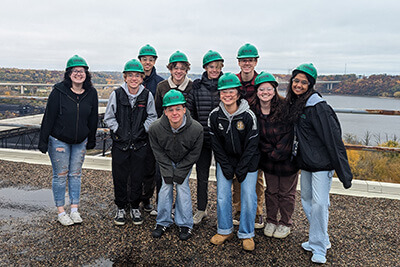
Field trip to Kings Power plant
Ms. Sullivan’s chemistry class recently ventured to the Allan S. King Power Plant in Marine on St. Croix. In their current unit on atmospheric chemistry, their studies delve into the intricate world of indoor and outdoor air pollution, including sulfur dioxide’s and nitric oxide’s role in acid rain formation, particulate matter, and more.

The class’s discussion naturally extended to the crucial topic of climate change, investigating its implications, and alternatives to fossil fuel usage. This field trip was a real eye-opener for students, offering a tangible connection between the discussion and theoretical knowledge gained in the classroom and its real-world application.

One main focal point of their excursion was to explore the cutting-edge technologies being used to remove sulfur dioxide, nitric oxides, and particulate matter at the King Power Plant and discover what makes it stand out among coal-burning facilities. Students had learned about these technologies in the environmental chemistry course, and even used stoichiometry calculations to determine how much calcium carbonate is needed to neutralize the sulfur dioxide that comes from burning coal in Minnesota, exemplifying the future-forward philosophy that is heavily integrated within MPA’s education.

Walking through the plant, students not only witnessed advanced environmental technologies but also engaged in conversations with the plant manager. These discussions provided insights into the career and economic implications of transitioning to renewable energy sources, reinforcing the vital link between science and society.

What made this experience even more remarkable was its origin—a chance encounter during parent-teacher conferences. Nick Martin, a parent who works for Excel Energy, noticed information about Ms. Sullivan’s atmospheric chemistry unit displayed on the board. Intrigued, he extended an invitation for MPA students to witness these concepts in action. Learning extends beyond the classroom at MPA, and the active involvement of our community members adds a unique dimension to the educational journey.

The King Power Plant, though set to discontinue coal usage by 2028, will be repurposed into a distribution hub for solar energy and other renewables. This aligns seamlessly with the class’s discussions on the evolving landscape of energy production and the imperative shift toward sustainability.

This field trip served as an invaluable opportunity for students to witness the practical applications of their academic pursuits. By experiencing firsthand the environmental technologies at play and understanding the broader societal impacts, they gained a deeper appreciation for the pivotal role science plays in addressing pressing global challenges.


MPA Dreamers: Parents Of Lifers

Quote from Kelsi Picture yourself in the position of a parent of a PreK or kindergartener, perhaps anxiously, but jovially, beginning your school search. If you are looking at a school like Mounds Park Academy, you want your child to grow into a free spirit, a risk taker, a right maker, a dreamer, and a doer. You want an independent thinker. You want your child to be known. You want your child to love school. Your role, as the parent in the school search process, will determine the foundational years of your child’s education. It seems that for parents of the Class of 2023 Lifers, the memory remains clear as day.

Parents of MPA Lifers, the students whose entire K-12 or PreK-12 journey has taken place here at MPA, made a choice for their students and continued to choose MPA every year for all 13 years of their education. Right before they graduated from MPA, we interviewed the Class of 2023 Lifers in a group reflection on their MPA journeys. Their responses and recollections, punctuated with gratitude, nostalgia, and undeniably helpful feedback, led us to further expand on the conversation. We decided we needed to hear from the Lifer parents, as well.

An MPA education emphasizes the value of purposeful academic rigor in a hands-on, experiential, college-prep environment with the goal of instilling a lifelong love for learning. So we asked:

How has MPA accomplished this for your children, helping them find personal and academic success?

Christine (Anthony ’23): Anthony’s a quiet kid, more on the introverted side. And I think one of the things, from preparing personally, is being somewhere this many years and really knowing people and having those longitudinal relationships with teachers, classmates, and other staff at school. It has really been beneficial for him as far as building confidence and being comfortable–coming out of his shell a little bit. The first time he came here, he was 10 days old, so by the time he came as a student, he was super comfortable and felt like it was somewhere that he was familiar with. I definitely think that’s made a difference for him.

John (Freya ’23): When it comes to Freya, one thing that I think has been beneficial for her academic success is the small size of the school and the exceptional students that she’s with. And some of those kids being so exceptional and doing such exceptional work has forced her to become a better student.

Natalie (Henry S. ’23): I couldn’t agree more. One thing I’ve been really pleased about and so proud of is the diversity that Henry’s experienced here. It’s something he was looking for in his college search, which I was just so profoundly impacted by. He’d say, “mom, that’s just not what I’m used to, and I’m looking for a school with more diversity.” That is MPA. I love that. Read More


MPA Dreamers: Lessons From Lifers

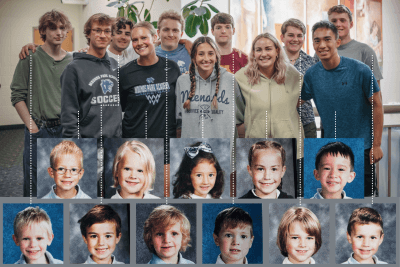
MPA Class of 2023 LifersIn the spring of 2011, some of the littlest dreamers in the school were wrapping up their first year together. These members of the Class of 2023 were sprinting around the track and testing their throwing skills at Track and Field Day, graduating from kindergarten, and nestling together to watch the seniors, the biggest kids in the school, say their bittersweet goodbyes at the Yearbook Assembly.

This week, they are those seniors, concluding their time at the only school they’ve been at for their entire academic career. As they graduate on June 3, 11 of them join MPA’s Joanne Olson Club, reserved for students whose entire K-12 or PreK-12 journey has taken place here at MPA.

Recently, members of this group–Henry Galicich, Aidan Harms, Griffin Jones, Nicholas Larson, Gabby Magistad, Jack Peterson, Freya Rahm, Henry Seum, Siri Springer, William Tan, and Anthony Troullier–gathered together for a group reflection on their MPA journeys. After all, who knows more about the MPA community than the students who joined in kindergarten and now leave the school as young adults, each bound for college and charting their own paths?

MPA teachers foster the ability to solve authentic, real-world problems. Students are empowered to be architects of their education, and furthermore, their lives. So we asked,

How has being a student at MPA shaped you?

Freya: My communication skills have definitely developed because of MPA. I’m able to express how I feel and what I need to say. I feel prepared to answer questions, and when I was applying for jobs, I felt ready.

Nicholas: Adding on that, we do a lot of class presentations and public speaking, and I think that’s an aspect that MPA students are really good at. On my swim team, we have to do something similar to senior speeches–when you graduate, you give a speech to the whole swim club at the end-of-the-year banquet. And a lot of my teammates were really nervous. But it was just another speech for me.

Siri: Also, we have so much one-on-one time with our teachers. Talking to them helps. You learn to talk to adults and it’s encouraging for things like interviewing for jobs. Read More


MPA Freethinkers: Student Leaders

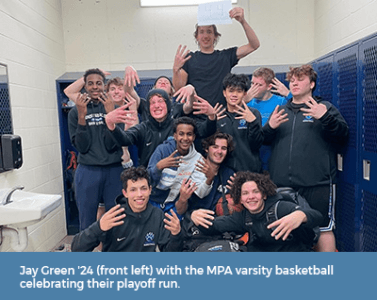
MPA varsity basketball celebrating their playoff run

“Leadership is being in the middle of the herd, moving it roughly westward.”

This is one of Head of School Dr. Hudson’s favorite metaphors that he learned from a mentor years ago. Dr. Hudson meets with the current senior class throughout the school year to walk them through various leadership theories and ideologies as they prepare for their journey after MPA. He shares this one with them, asking them to think about how it applies to leadership in their own hands. When they unpack it together, common themes arise:

  • If a leader is at the tail end, the herd lacks direction. On the other hand, sometimes a leader needs to step back in order to consider crafting a broader vision.
  • Those who lead from the middle are often better in touch with other members of the herd and can nudge them forward in a common direction. They help others feel valued as a part of the solution as the team moves ahead.
  • Sometimes a leader needs to be bold and chart a new path.

We teach our students that leadership requires adaptability, responsiveness, and resilience. When we look at the freethinkers among our student community, student leaders do not come one-size-fits-all. They are leaders of clubs, team captains, and thought leaders. In Lower School, fourth graders are the conflict managers to help resolve conflicts on the playground. In Middle School, eighth graders set an example for all other grades, and are the peers who make themselves available and approachable for help. In Upper School, Peer Leaders take on being role models for the school, teaching others what leadership is to them. At every stage of their education, empowering students to live, learn, and thrive means guiding them and infusing their education with leadership skills–many of which are learned through experience. Read More