May 11, 2020
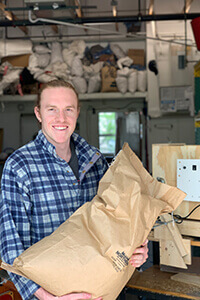 Nick Gardner ’15 is one of just three employees at Perennial Pantry, a small startup, but he is helping to bring about big changes to the world of sustainable agriculture.
On May 4, Perennial Pantry debuted Kernza® Perennial Grain, a grain in the wheat family. Kernza is a perennial, which means it can be left in the field for several years without needing the annual tilling that damages topsoil and leads to erosion and nutrient losses. Kernza develops deep root systems that help sequester carbon, filter water, and keep continuous living cover on the land, creating a habitat for pollinators, song-birds, and wildlife. Kernza is designed to be climate positive, meaning that growing it doesn’t just have a net zero carbon footprint, but actually fights climate change by removing additional carbon dioxide from the atmosphere.
Nick has been heavily involved in the Kernza project. He has conducted product research, done mathematical modeling, written web content, and edited promotional videos. He also built a grain separator and dehuller himself (with the help of his dad’s shop) using open source plans and his own design work, saving the startup tens of thousands of dollars.
“I’ve been doing a lot of dehulling, cleaning, and milling tests,” he says, noting that grain distributors like Perennial Pantry can be a forgotten part of the supply chain. “Processing grain and flour takes a lot of work! It’s hard enough with something like barley or wheat, but Kernza is so new, and it’s been bred with ecosystem services and taste in mind, not uniformity.”
Nick is also involved in baking research and familiarizing himself with Kernza in order to communicate most effectively with chefs, bakers and brewers. “I love working at Perennial Pantry–every day is something new. One day I’m fine-tuning settings on our processing equipment or doing research to develop best practices. The next day, I’m communicating the amazing potential of perennial agriculture to journalists, consumers, friends, or just about anyone I can reach. I have a lot fun.”
Perennial Pantry has partnered with nationally known organizations including the Land Institute in Kansas and the University of Minnesota’s Forever Green Initiative to launch Kernza. They are bringing necessary agricultural products to consumers in a just manner while also communicating the impact that perennials can have on sustainable and climate positive supply chains in agriculture.
Nick earned a double major in Environmental Justice and Mathematics at Williams College and is thankful that much of what he’s doing has roots in what he learned at MPA, and in college. His work with Perennial Pantry combines his lifelong interest in environmental sciences with a passion for doing right. “MPA encouraged excellence in a lot of things. Of course I loved math and science, but what I learned in social studies and fine arts comes into play on a daily basis too.”
“One day I’m choosing a color palette for a new advertisement, and the next I’m using mathematical modeling to predict the carbon impact that 1 million acres of Kernza could have over time,” Nick says. “I’ve felt very thankful for my work ethic and the diversity of my education. And it began at MPA.”
Learn more Nick’s work with Kernza at the Perennial Pantry website and on YouTube!
 by Dr. Bill Hudson, Head of School
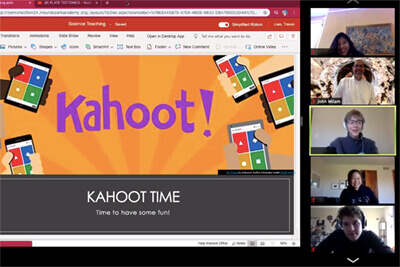 A spirit of innovation flows through all that we do at Mounds Park Academy; now it’s just through high-speed Internet instead of hallways and classrooms. Innovation fuels creative thinking and allows students to experience the joy of learning—and thanks to John Milam’s seventh- and eighth-grade science courses—the joy of teaching.
 It’s a bright September day and students are streaming energetically into Anne Atchison’s eighth grade English class. On this day, the class has a guest speaker, Carlos Espinosa, who fled Cuba as a child in the 1960s. Carlos is here as part of the class’ discussion on Refugee, a novel recounting children fleeing their homeland in pursuit of a better life. For nearly the entire 75 minute block, Carlos captivates the class with the story of his escape to the United States. There’s even time for questions at the end, and the eighth graders ask away.
 With virtual school now in place for the remainder of the school year, Mounds Park Academy wants to share some tips to help Lower School families thrive. These times are not easy for parents of younger students especially and MPA is committed to helping them navigate life through the end of the school year and perhaps even emerge stronger.
 by Dr. Bill Hudson, Head of School
 How we work, and therefore, how we prepare students for their future careers, is changing rapidly in the time of COVID-19. A meteoric rise in telecommuting, virtual learning, and video conferencing has reinforced the tremendous speed at which the work world changes in the 21st century. In fact, the nature of jobs themselves are transforming as antiquated job models are being phased out and new approaches are taking center stage. The fundamental change in career paths and professional expectations, brought on by globalism and technology, and accelerated by COVID-19, is shaping and illustrating how progressive independent schools like Mounds Park Academy prepare students for life beyond the four walls of a classroom.
 by Dr. Bill Hudson, Head of School
 This story series illustrates how our community is embracing, growing, and connecting through virtual learning together. Read on to hear MPA junior Dhruv Muppidi’s experience as #MPAgoesvirtual!
 The MPA Upper School Asian Culture Club, Social Consciousness Club, and Racial Justice and Equity Club met on Zoom to discuss how the language around COVID-19 can produce hate and racism. Students had the opportunity to share personal reflections anonymously, and the conversation will be a part of a continuing ‘series’ on the social and political impacts of this health crisis and a broader effort to document their responses. In this blog post, MPA senior Amanda Khouw shares how she is working and speaking out to eliminate stereotypes and misinformation.